
Anonymity in Delaware (And How It Compares to Texas, Nevada, and Wyoming)
January 29, 2026 | By Kevin Vela
“Anonymous LLC” is one of the most common phrases I hear from founders and business owners. Almost every time, what they really want is simple: to form a company without their name being easy to find in a public Secretary of State search.
That’s a realistic goal in some states. It’s not realistic in others. Even in the best-case scenario, “anonymous” does not mean invisible. Banks, investors, title companies, and sophisticated counterparties still ask who owns and controls an entity. Courts and regulators can still require disclosure. If you operate in a state with heavier compliance and reporting obligations, that state can create its own public record trail regardless of where you originally formed the entity.
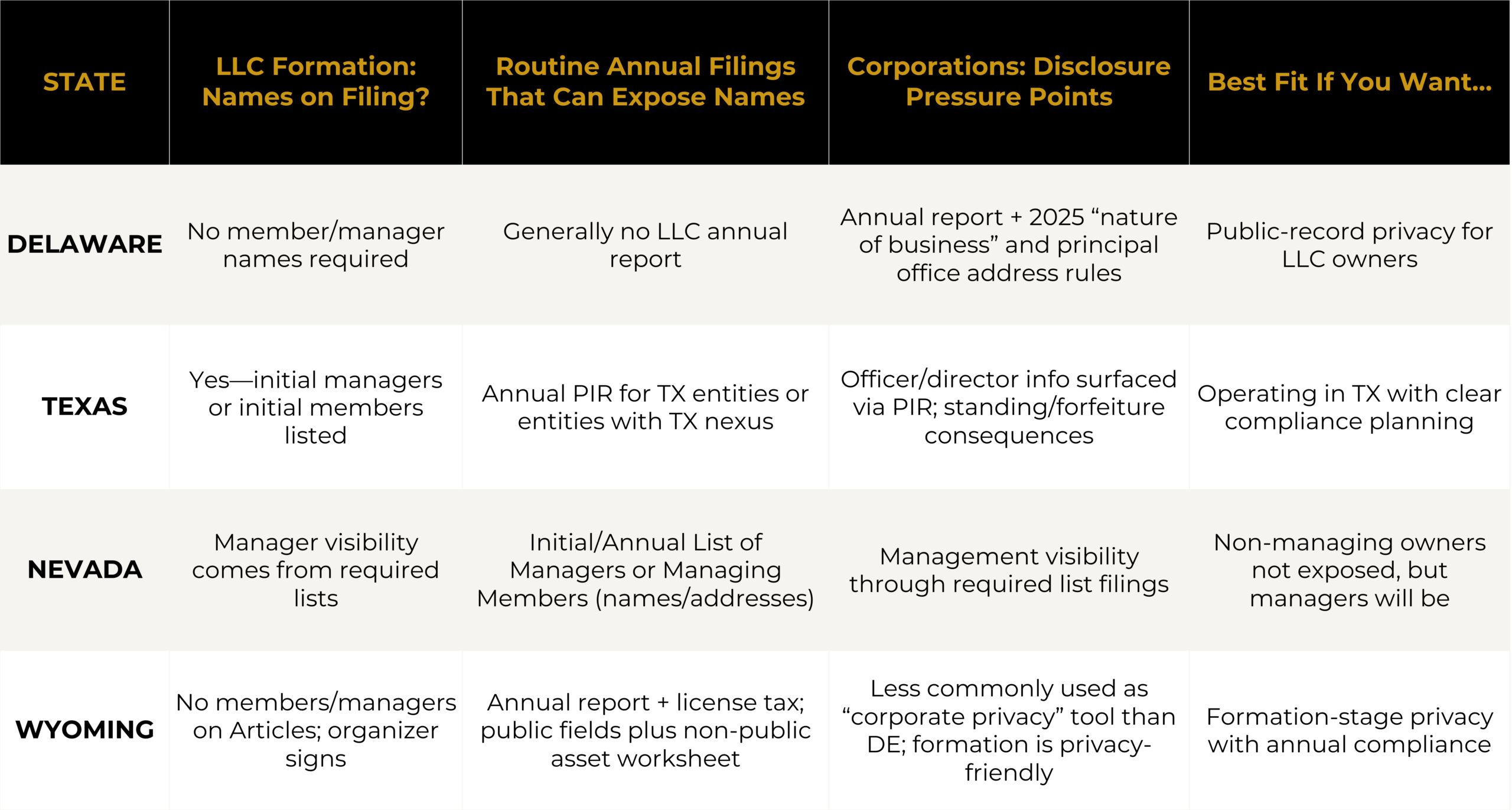
This post is intended to be a straightforward comparison of how Delaware handles public-record privacy, and how it stacks up against Texas, Nevada, and Wyoming at both the formation stage and in ongoing compliance.
What Anonymity Actually Means (And What It Doesn’t)
When a client asks for an anonymous entity, they are usually asking whether the state requires owners or managers to be listed in the public formation documents. That is the right question, but it is only part of the analysis.
Even if the state filing does not require names, ownership and control information still comes up regularly in real life, including through:
- bank onboarding and KYC requirements
- financing and investor diligence
- platform compliance (payment processors, marketplaces, lenders)
- vendor onboarding and counterparty diligence
- litigation, subpoenas, regulatory requests, and court proceedings
The best way to frame this is that state choice can reduce public-facing visibility, but it does not eliminate ownership disclosure when it matters.
Delaware (DE)
Delaware remains one of the strongest jurisdictions for clients who care about public-record privacy.
Delaware LLCs
- LLC Formation: Delaware’s Certificate of Formation does not require member or manager names on the public filing. Registered agent details are public.
- LLC Ongoing: Delaware generally does not require an annual report for LLCs, which means fewer routine public updates than many states.
Delaware Corporations
Delaware corporations are subject to recurring reporting obligations, including an annual report and franchise tax. Delaware’s 2025 amendments also increased disclosure requirements for corporations by adding “nature of business” reporting and tightening principal office address rules.
CTA Update: BOI Reporting Is Not Playing Out the Way Most People Expected
When the Corporate Transparency Act (CTA) passed, many people assumed it would effectively end the concept of private ownership from a compliance standpoint because of beneficial ownership reporting (BOI) to FinCEN.
Since then, implementation has shifted significantly due to litigation and federal policy changes. As of January 2026, BOI reporting generally applies to foreign entities registered to do business in the United States, rather than typical domestic entities formed in the U.S.
Two practical points are still worth keeping in mind:
- Even when BOI reporting applies, the BOI database is not intended to be publicly searchable the way state entity searches are.
- Banks and counterparties still routinely request ownership and control details regardless of whether CTA reporting applies.
Texas (TX)
Texas tends to create more public-facing disclosure points than Delaware, both at formation and through ongoing compliance.
- LLC Formation: Texas’s Certificate of Formation is a public record and requires disclosure of the initial governing persons (initial managers if manager-managed; initial members if member-managed).
- Ongoing Compliance: Texas franchise tax reporting commonly includes filings such as the Public Information Report (PIR). Officer and director information from these filings is reflected in public-facing searchable records, though certain ownership information reports may be treated as confidential.
- Practical Effect: Even if an entity is formed elsewhere, doing business in Texas can create recurring Texas compliance and public record touchpoints.
Nevada (NV)
Nevada is often marketed as privacy-friendly, but routine filings can make management visibility difficult to avoid.
- LLC Ongoing Disclosure: Nevada requires an Initial/Annual List of Managers or Managing Members, including names and addresses.
- Practical Effect: If the goal is to keep the individuals with management control out of routine public filings, Nevada often works against that goal.
Wyoming (WY)
Wyoming can be a strong option at formation for public-record privacy, but it comes with annual compliance that some clients overlook.
- LLC Formation: Wyoming’s Articles of Organization generally focus on registered agent and address information and do not require listing members or managers.
- LLC Ongoing: Wyoming requires an annual report and a license tax tied to assets located and employed in Wyoming.
- Practical Effect: Wyoming can be privacy-friendly at formation, but clients should account for annual reporting and address disclosures.
Quick Comparison For Clients Choosing Among DE, TX, NV, and WY
If you are selecting a jurisdiction based primarily on public-record privacy and routine disclosure points:
- Best public-record privacy at LLC formation: Delaware and Wyoming
- Most likely to disclose managers/managing members through routine compliance: Nevada
- Most likely to create recurring public disclosure tied to doing business in-state: Texas
Final Thoughts
Delaware remains a strong option for clients focused on limiting public-record visibility of LLC ownership and control. Wyoming is often comparable at the formation stage but includes annual report obligations that can create disclosure points. Nevada and Texas are more likely to produce ongoing public-facing visibility through routine filings.
Regardless of state choice, anonymity is never absolute. Banks, counterparties, regulators, and courts can still require ownership and control disclosure depending on the situation.
About the Author(s)

Kevin Vela
Kevin is the managing partner at Vela Wood. He focuses his practice in the areas of venture financing, M&A, fund representation, and gaming law.
Learn More